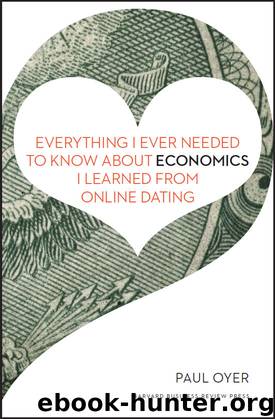
Everything I Ever Needed to Know about Economics I Learned from Online Dating by Paul Oyer
Author:Paul Oyer
Language: eng
Format: mobi, epub
ISBN: 9781422191651
Publisher: Harvard Business Review Press
Published: 2013-12-16T14:00:00+00:00
Thick Markets Lead to More Specialization
So size matters and, all else being equal, a bigger dating site is better. But all else is not equal in this context. If I will consider dating only tennis players or vegetarians, then a much smaller set of potential dates from TennisDate.com or VeggieDate.com may well be better than the Match.com options. So how do I decide whether to be a generalist (that is, use Match.com) or a specialist (on the tennis or vegetarian sites)?
Specialist dating sites may well be the way to go if you are truly passionate about a particular aspect of your potential mate, but the local market size matters a lot here, as well. Let’s assume that 5 percent of the people in a given area are vegetarians (a figure around the typical level for most Western countries). Then vegetarians rule out nineteen out of every twenty potential mates if they insist on partners who are also vegetarian. For a vegetarian who lives in Manhattan, this restriction limits his options considerably but should not be insurmountable, given that he lives within a few square miles of literally millions of other people. In that area, there have to be plenty of single female vegetarians. But a vegetarian in a small city is likely to find that he either has to compromise his insistence on dating only other vegetarians or compromise on some other dimension to find a partner. The bottom line, then, is that TennisDate.com and VeggieDate.com are much more viable options in densely populated areas where there are more people with this specialized interest packed into the region.
The concentration of gay people in urban areas is probably caused by a confluence of factors, but market thickness is surely a big one. Estimates vary, but fewer than 5 percent of people are self-declared to be exclusively homosexual. Living in a small town, then, is more limiting when searching for a same-sex partner than when looking for a mate of the opposite sex. While approximately 75 percent of American heterosexual couples live in an urban area, 85 percent of lesbian couples and 90 percent of gay male couples are in cities. The search for thicker markets is also likely to be at least part of why only a third of partners in same-sex couples were born in the same state, while for heterosexual couples the figure exceeds 50 percent.
Just as it behooves the online dater in a less populated area to be more of a “generalist,” providers of services in less-populated areas also tend to be less specialized. Consider a doctor setting up a practice in Emporia, Kansas (population 24,916) versus a doctor in Palo Alto, California (which is part of a metropolitan area with millions of people). There are plenty of doctors in Emporia, but there are no dermatologists and just two orthopedic surgeons. People in Emporia who want such specialized services must drive more than an hour to Topeka or Wichita.
The market in Emporia is simply not big enough for
Download
Everything I Ever Needed to Know about Economics I Learned from Online Dating by Paul Oyer.epub
This site does not store any files on its server. We only index and link to content provided by other sites. Please contact the content providers to delete copyright contents if any and email us, we'll remove relevant links or contents immediately.
International Integration of the Brazilian Economy by Elias C. Grivoyannis(111078)
The Radium Girls by Kate Moore(12035)
Turbulence by E. J. Noyes(8057)
Nudge - Improving Decisions about Health, Wealth, and Happiness by Thaler Sunstein(7712)
The Black Swan by Nassim Nicholas Taleb(7137)
Rich Dad Poor Dad by Robert T. Kiyosaki(6646)
Pioneering Portfolio Management by David F. Swensen(6305)
Man-made Catastrophes and Risk Information Concealment by Dmitry Chernov & Didier Sornette(6027)
Zero to One by Peter Thiel(5808)
Secrecy World by Jake Bernstein(4756)
Millionaire: The Philanderer, Gambler, and Duelist Who Invented Modern Finance by Janet Gleeson(4482)
The Age of Surveillance Capitalism by Shoshana Zuboff(4310)
Skin in the Game by Nassim Nicholas Taleb(4257)
The Money Culture by Michael Lewis(4212)
Bullshit Jobs by David Graeber(4197)
Skin in the Game: Hidden Asymmetries in Daily Life by Nassim Nicholas Taleb(4012)
The Dhandho Investor by Mohnish Pabrai(3775)
The Wisdom of Finance by Mihir Desai(3754)
Blockchain Basics by Daniel Drescher(3586)
